Introduction
For this investigation, the class of Biology 1122 visited the Bermuda Aquarium in order to observe and identify the many different phylums that we have been studying in class. We were given a list of definitions along with their descriptions and our objective was to explore the aquarium, zoo and museum to find the organism (dead or alive) that best suited each description. We then had to find the scientific name for each organism found, and record its class name, family name and its location.
The Invertebrate Features:
Domain: Eukarya
Kingdom: Animalia
Phylum: Porifera, Cnidaria, Molluscs, Annelida, Arthropods, Echinodermata
1.Triploblastic Organism
Possessing three germ layers (tissue layers): the endoderm, mesoderm, and ectoderm. Most invertebrates except sponges have 3 germ layers. Found in organisms and the relatives of snails, worms, crustaceans, and insects.
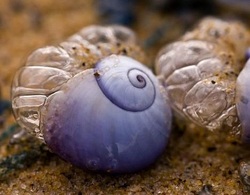
Example: Purple Sea Snail
Phylum: Cnidaria
Class: Gastropoda
Family: Janthinidae
Found: Within the Museum
Phylum: Cnidaria
Class: Gastropoda
Family: Janthinidae
Found: Within the Museum
2. Deuterostome Development:
In animals a development mode distinguished by the development of an anus from the blastopore, often characterizes by radial cleavage and by the body cavity forming as outpockets of mesodermal tissue. Found in organisms and the relatives of sea stars and all vertebrates.
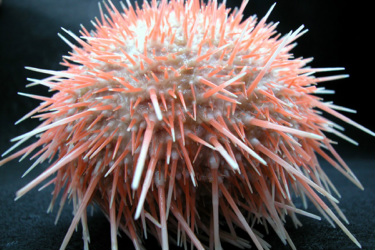
Example: Pale Sea Urchin
Phylum: Echinodermata
Class Name: Echinoidea
Found: Aquarium
Phylum: Echinodermata
Class Name: Echinoidea
Found: Aquarium
3. Protostome Development:
In animals, a developmental mode distinguished by the development of the mouth from the blastopore; often characterized by spiral cleavage and by the body cavity forming when sold masses of mesoderm split. Found in organisms groups other than those mentioned in #2.
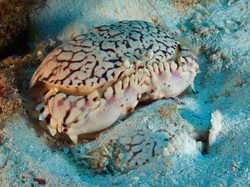
Example: Flaming Box Crab
Scientific Name: Calappa Flammea
Found: Aquarium
Scientific Name: Calappa Flammea
Found: Aquarium
4. Spicules:
Found in some sponges these are sharp, skeletal fiber structures are made up of calcium carbonate or silica. These “asymmetric” organisms are found around Bermuda attached to rocks or any underwater substrate.
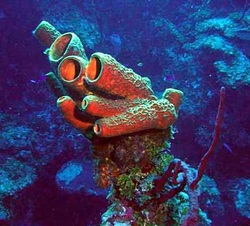
Example: Sea Sponge
Phylum: Echinodermata
Found: Aquarium
Phylum: Echinodermata
Found: Aquarium
5. Bilateral Symmetry:
A bilateral animal has a right and left side. All vertebrates have bilateral symmetry. Find bilateral symmetry in an invertebrate such as in the phylum Arthropods. Guys these organisms simply put have a head! This is referred to as Cephalization.
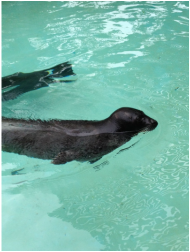
Example: Sea Lion
Phylum: Chordata
Class Name: Mammalia
Family Name: Otartiidae
Found: Zoo/Aquarium
Phylum: Chordata
Class Name: Mammalia
Family Name: Otartiidae
Found: Zoo/Aquarium
6. Radial Symmetry:
A radial animal such as those that provide habitats for “Clown fish” (remember Nemo?) display a body symmetry where there are no right and left sides but rather mirror images when an imaginary slice is taken through the central axis.
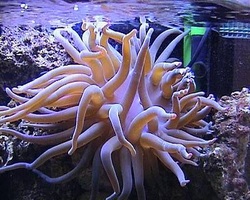
Example: Sea Anemone
Phylum: Cnidaria
Class Name: Anthozoa
Found: Touch Pool Area
Phylum: Cnidaria
Class Name: Anthozoa
Found: Touch Pool Area
7. Budding:
This method of asexual reproduction involves an outgrowth from one parent and pinch off to live independently or remain attached to eventually form extensive colonies. Found in our oceans around Bermuda (northern most reef system).

8. Polyp:
This is opposite of a Medusa body form where motility is permitted. Some members of Phylum Cnidaria however are sessile (stationary) form attached to some substrate. This body form can be found in the aquarium (water exhibits) and all over Bermuda. These animals live symbiotically with algae!
9. Gastrovascular Cavity:
A central cavity with a single opening in the body of certain animals that function in both the digestion and distribution of nutrients. See # 8 body plan (polyp) with a gastrovascular cavity.
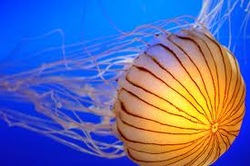
Example: Jellyfish
Phylum: Cnidaria
Found: Aquarium
Phylum: Cnidaria
Found: Aquarium
10. Nematocyst:
A stinging tentacles/cells found with Phylum Cnidaria. These include floating organisms around Bermuda that long tentacles that span underwater far beyond the body of this creature….so watch out swimmers! Campbell describes this feature contained in a cnidocyte of a cnidarian, a specialized capsule like or organelle containing a coiled thread that when discharged can penetrate the body wall of the prey.
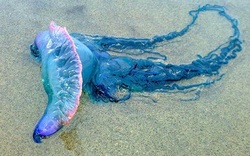
Example: Portuguese Man of War
Phylum: Cnidaria
Class Name: Hydrozoa
Family Name: Physallldae
Found: N/A
Phylum: Cnidaria
Class Name: Hydrozoa
Family Name: Physallldae
Found: N/A
11. Molting:
The shedding of a chitin exoskeleton to enable the organism to grow and produce a larger exoskeleton. Found in members of Phylum Arthropoda (you may see remnants of exoskeletons on rocky coastlines).
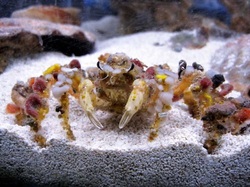
Example: Decorator Crab (Naxia Tumida)
Phylum: Anthropoda
Class Name: Malacostraca
Family Name: Majidae
Found: Touch Pool Area
Phylum: Anthropoda
Class Name: Malacostraca
Family Name: Majidae
Found: Touch Pool Area
12. Jointed Appendages:
These are extension off the body of members of Phylum Arthopods (most successful organisms). These include antennae, pincers, mouthparts, walking legs, and swimming.
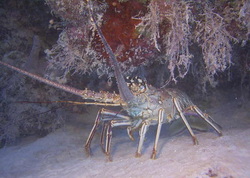
Example: Spiny Lobster
Phylum:
Phylum:
13. Segmented Body:
Organism can include invertebrates and vertebrates where clearly defined body divisions are visible. In Arthropods (some found in the soils, some can fly) a head, thorax, and abdomen region can be seen. In some segmented organisms one may find many identical regions that make up the organisms body instead.
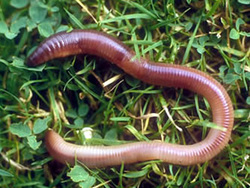
14. Torsion:
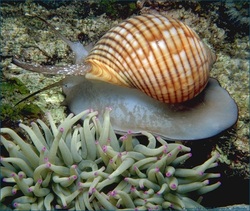
A developmental process seen in Gastropods (can be found in the garden and have a shell) in which the visceral mass rotates up to 180 degrees causing the animals anus and mantle cavity to be positioned above its head.
15. Filter Feeder:
Rely on currents to bring forth nutrients. These invertebrates are sessile (stationary). Phylum porifera and phylum cnidarian have filter feeders. Many can be seen in the North Rock exhibit.
16. Tubed Feet:
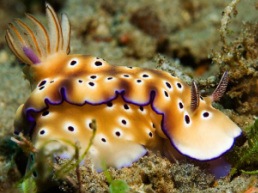
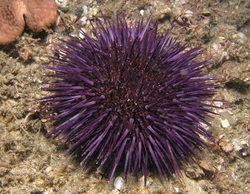
One of numerous extensions of an echinoderm’s water vascular system. Tube feet function in location, feeding, and gas exchange underwater. Hint! These have the ability to regenerate.
17. Complete Metamorphosis:
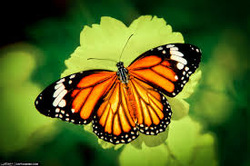
The transformation of a larva into an adult that looks very different, and often functions very differently in its environment, than the larvae. Observed in both vertebrates and invertebrates. Phylum Arthropod and Subphylum Vertebrata.
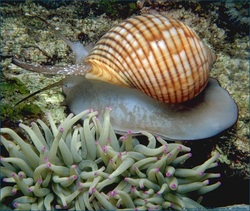
18. Mantle:
One of three main parts of a mollusk; a fold of tissue that drapes over the molluscs visceral mass and may secrete a shell. Molluscs move slow and can be found on a dinner menu!
19. Incomplete Metamorphosis:
A type of development in certain Arthropods (insects) in which the young resemble the adults (young are referred to as Nymph). The Nymphs are smaller and have different body proportions. The nymph goes through a series of molts each time looking more like the adult until it reaches full size.